
Anti-ageing
GHK-CU
100mg · GHK-Cu copper peptide
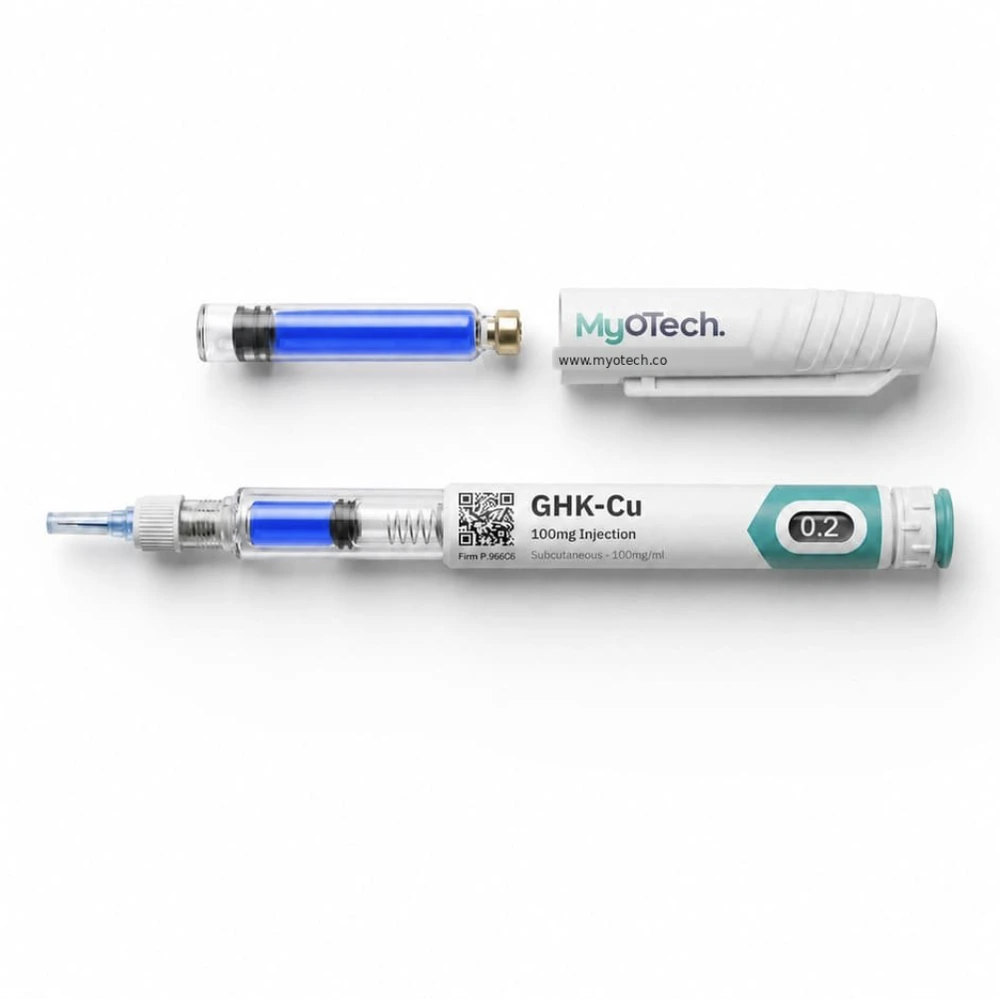
Copper peptide studied for skin regeneration, collagen support, tissue repair, and advanced beauty-focused peptide research.
Benefits
- Skin regeneration
- Collagen support
- Tissue repair
- Firmness and elasticity
How long will my pen last?
Your body. Your response.
Track the small changes
- Skin texture and firmness
- Fine lines
- How marks settle
- A monthly photo
What it is
GHK-Cu is a copper peptide. The GHK part is a tripeptide, three amino acids in a row: glycine, histidine and lysine. It has a strong affinity for copper, and when a copper ion is bound to it the pair is written GHK-Cu. In cosmetic ingredient lists the same molecule appears as copper tripeptide-1. The sequence occurs in nature. GHK was first isolated from human plasma, and it also occurs naturally in saliva and urine. Most of the research on GHK-Cu sits in the context of the skin and of tissue repair. GHK-Cu has been studied for its role in collagen-related processes, in skin remodelling and in the behaviour of fibroblasts, the cells that build connective tissue. It has also been researched around tissue regeneration in laboratory models. None of that is a promise about what the product does for anyone; it is a description of where the compound has been looked at.
What is in the pen
One peptide, nothing else alongside it. The label reads GHK-CU at 100mg, and that figure refers to the single compound in the pen, so it is a plain number rather than a total shared across a blend. It is supplied as an injection pen: a 3ml cartridge with 12 needles, the same format as the rest of the injectable range. Between one pen and another in the range only the strength changes; the cartridge and the needle count stay the same.
How it is tested
Every product in the range is tested by Janoshik Analytical, an independent laboratory, and the reports are published rather than described. The ones held for this product are linked above, each named by the compound it covers, and every link goes to verify.janoshik.com, the laboratory's own domain, not to a file hosted on this site. That distinction is the whole point: a report on the laboratory's own server is a record a seller cannot edit, while a certificate hosted on a shop's own website is a picture of one. A report is evidence of identity and purity for the sample submitted, and nothing else. If you want to know what has been tested most recently before you order, ask on WhatsApp and you will get a straight answer.
Common questions
- Is GHK-Cu the same thing as copper peptide?
- Copper peptide is the loose name. GHK-Cu is the specific one: the tripeptide GHK with a copper ion bound to it, listed in cosmetic ingredients as copper tripeptide-1. Other copper peptides exist, AHK-Cu among them, and they are different molecules.
- Can I collect GHK-Cu in Marbella, or is it sent from abroad?
- The stock is held in Marbella. Message the WhatsApp number and collection in person or delivery along the coast is arranged in the same conversation, usually the same day when it is in stock here. If Marbella is sold out, the same product is generally available from the United Kingdom on the same number.
- What is the difference between this pen and the GHK-Cu + AHK-Cu pen?
- This pen holds GHK-Cu alone, 100mg of a single peptide. The GHK-Cu + AHK-Cu pen splits its 100mg between two copper peptides, 50mg of each, and AHK-Cu is the part that has been studied in the context of the hair follicle. They are two separate products in the range.
Research use only. Every product on this page is supplied for laboratory research use only. Not for human or veterinary use, and not a medicine. Understanding how you are responding helps when reviewing whether your programme is still right. We do not publish dosing amounts; any change to dosing should be discussed with a qualified healthcare professional.